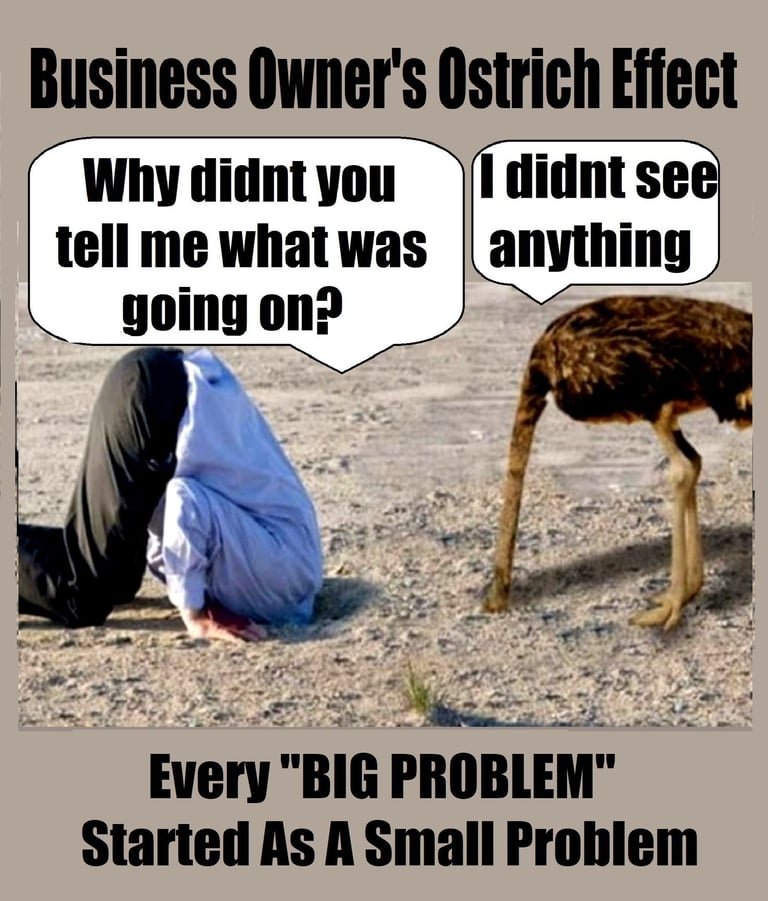
Every "Big Problem" Started as a Small One:
A minor communication breakown becomes a customer complaint. A small scheduling oversight snowballs into a productivity crisis. An unaddressed employee concern turns into your best performer walking out the door. Every catastrophic business problem you've ever dealt with started as something manageable
Kevin Deon Norton
1/22/20267 min read

Training Middle Managers to Catch Issues Early
You've seen it happen. A minor communication breakown becomes a customer complaint. A small scheduling oversight snowballs into a productivity crisis. An unaddressed employee concern turns into your best performer walking out the door.
Every catastrophic business problem you've ever dealt with started as something manageable. The question isn't whether small problems exist in your organization: they always do. The question is: Who's catching them before they metastasize?
The answer should be your middle managers. They're positioned at the exact intersection where operational reality meets organizational strategy—MIDDLE MANAGEMENT IS THE HARDEST JOB IN ANY ORGANIZATION—because most things break in the middle. They see what's actually happening on the ground, hear the conversations happening in the breakroom, and feel the friction points in real-time. But here's the catch: most middle managers are either not trained at all—or they’re poorly trained—for actual leadership. They’re handed a title, a stack of responsibilities, and maybe a policy manual, then expected to magically know how to lead humans. That training gap is the root cause of why things break in the middle—and why issues that should be manageable turn into preventable crises.
And that training gap is costing you: in lost productivity, employee turnover, customer satisfaction, and preventable crises.
The Early Warning System You're Not Using
Middle managers possess what researchers call "ground-truth information": the most accurate, unfiltered understanding of what's working and what's breaking down. They know which team members are struggling before it shows up in performance metrics. They hear the grumbling about a new policy before it becomes active resistance. They spot the process inefficiency that's adding three unnecessary hours to everyone's workweek.
But in most organizations, this early-warning intelligence never reaches decision-makers. Why? Because middle managers weren't hired to be problem-spotters: they were hired to keep things running. And in many corporate cultures, surfacing problems is perceived as complaining, lacking solutions, or worse: being a poor manager who "can't handle their team."
This is the fundamental disconnect. Visionary owners and executives are looking at the future—growth, strategy, margin, market position—while front-line staff are dealing with today's reality—customers, schedules, handoffs, and bottlenecks. The “break” happens in the middle when managers aren’t trained to lead, translate, and align both sides. You need your middle managers to catch small fires before they become infernos, but you've created an environment where pointing out smoke feels risky.
The result? Problems fester. Small issues compound. And by the time leadership hears about it, you're not putting out a match: you're dealing with structural damage—because the people best positioned to see the smoke weren’t equipped (or safe) to say something early.
Quality Control IS Quality Assurance
At Brubaker Quality Control, we operate on a principle that's not up for debate: Quality Control is Quality Assurance. It's not enough to inspect for problems after they occur. Real quality management means creating systems that prevent problems from escalating in the first place.
This same principle applies to your management structure. You can't rely on annual reviews and exit interviews to understand what's going wrong. You need middle managers who function as continuous quality assurance agents: constantly scanning for deviations, addressing small concerns immediately, and creating feedback loops that prevent problems from growing.
But this requires a fundamental shift in how you develop your management team.
From "Boss" to Leader: The Mentality Shift That Changes Everything
Here's a hard truth: Traditional "boss" mentality actively prevents early problem detection. And it gets worse in the middle—because most things break in the middle when managers are stuck acting like a task-enforcer instead of a people-developer.
Most middle managers were promoted because they were excellent at the work. They were a top producer, a reliable technician, the person who could “get it done.” That’s the doer phase. Then we do what most companies do: we promote the great doer and call it “leadership.” And that’s where we fail them.
The promotion changes the job: you’re no longer measured by what you do—you’re measured by what your people do. That’s the shift from DOER to LEADER: you’re now responsible for the people who do the job. Yet in most organizations, nobody is teaching them the core human skills—listening, communication, and effective confrontation—so they default to what they’ve seen before: a Boss mentality (control, pressure, compliance) instead of becoming the Leader the company actually needs.
Bosses focus on control, compliance, and maintaining appearances. They create cultures where team members hide problems rather than surface them. They micromanage tasks but miss the underlying dysfunction. They measure activity instead of outcomes, and they punish messengers who bring bad news.
Leaders, on the other hand, create psychological safety. They build environments where employees feel comfortable raising concerns without fear of being penalized. They coach rather than command. They ask questions that uncover hidden friction instead of assuming everything's fine because numbers look okay on a spreadsheet.
> Critical takeaway: When managers aren’t trained to lead, the disconnect between visionary owners and front-line staff widens—and the “break” shows up as missed handoffs, slowdowns, and problems that escalate unnecessarily.
This isn't soft skills fluff: this is fundamental to fostering operational excellence. When your middle managers operate as leaders rather than bosses, three things happen:
Problems surface earlier because team members trust their manager will handle concerns constructively
Solutions emerge faster because managers coach their teams to think critically rather than simply execute orders
Employee retention improves dramatically because people don't leave companies: they leave bad managers
The companies that understand this distinction experience up to 40% productivity increases and measurably lower turnover. The ones that don't? They keep wondering why their "best people" keep leaving.
The Four Skills Middle Managers Need (But Weren't Taught)
Most middle managers were promoted because they excelled at technical work: not because they demonstrated ability to spot organizational risk or develop people. This is your responsibility to fix. In plain terms: we take a great doer, give them a manager title, and then we do nothing to educate them in leadership. Nobody is teaching them the human skills that make teams work—so the middle becomes the failure point and most things break in the middle.
The “missing pieces” we see over and over—especially where small problems escalate into big ones—are these four skills: active listening, communication, effective confrontation, and the feedback loop. Here are the four competencies your middle managers need to catch small problems before they explode:
1. Proactive Risk Identification
Train managers to conduct weekly "friction audits." This isn't formal or bureaucratic: it's a simple mental checklist:
What task took longer than expected this week, and why?
Which team member seemed disengaged or frustrated?
What customer feedback (even minor) indicated a process gap?
Where did we create workarounds instead of fixing root causes?
These questions reveal small problems while they're still small.
2. Active Listening + Coaching-First Communication
Replace directive management with coaching conversations—and back it with active listening (not waiting to talk, not defending, not “fixing” too fast). Instead of "Here's what you need to do," effective managers ask:
"What's getting in your way?"
"If you could change one thing about how this process works, what would it be?"
"What support do you need that you're not getting?"
This approach surfaces issues employees weren't even planning to mention because you've signaled you actually want to hear them—and because you’re building the communication bridge where most things break in the middle.
3. Effective Confrontation + Upward Transparency Without Career Risk
Here's the organizational truth no one talks about: Middle managers learn quickly that surfacing problems can damage their standing. If bringing up a staffing concern makes them look like they "can't handle their team," they'll stop bringing up concerns. Period.
This is where effective confrontation becomes a core leadership skill. Not aggressive. Not avoidant. Direct, respectful, and timely. When a manager can confront issues early—missed expectations, sloppy handoffs, attitude shifts—small problems don’t get the time to grow teeth.
You must also create explicit channels where managers can report operational reality without it reflecting poorly on their performance. This means:
Regular skip-level meetings where senior leadership hears directly from teams
Anonymous feedback mechanisms that validate manager observations
Rewarding managers who surface problems early (even if it temporarily makes them look bad)
If your culture punishes transparency, you'll never have an early warning system—and the “break in the middle” becomes your default operating condition.
4. The Feedback Loop (Micro-Learning + Continuous Development)
Forget the three-day offsite training retreat. Research shows that continuous, bite-sized learning tied to current challenges creates sustainable behavior change. Middle managers need:
Monthly peer forums where they share what's working and what's not
Just-in-time training modules on specific skills (conflict resolution, difficult conversations, performance coaching)
Access to leadership mentors who can help them navigate complex situations in real-time
Most important: you need a feedback loop that forces learning to show up on the floor—observe → adjust → follow up → repeat. Without that loop, training becomes “nice ideas” instead of behavior change, and small problems keep escalating because nothing gets reinforced.
This isn't optional professional development: it's operational infrastructure.
Building Your Early Detection System
Ready to transform your middle managers into an early-warning system? Here's the practical framework:
WEEKLY: Each manager conducts a 15-minute friction audit and documents one emerging issue (even if minor)
BI-WEEKLY: Peer learning sessions where managers share patterns they're seeing and crowd-source solutions
MONTHLY: Leadership review of aggregated concerns to identify systemic issues vs. isolated incidents
QUARTERLY: Staff Assessments that measure both manager effectiveness and organizational health indicators
This cadence creates rhythm without bureaucracy. You're not adding administrative burden: you're creating structured space for the intelligence that already exists to actually reach decision-makers.
The Brubaker Human-Centered Management Approach
Our Leadership Development Program is meticulously crafted around a simple premise: You cannot build an excellent organization with "boss" mentality managers. You need leaders who see their role as developing people, not controlling them.
We guarantee measurable results because we focus on behavioral change, not information transfer. Our program includes:
Comprehensive assessments that identify current management gaps and friction points
Practical coaching frameworks your managers can implement immediately
Ongoing support structures that prevent backsliding into command-and-control patterns
Tools for creating psychological safety so problems surface early
We also include three hours of consultation to customize the approach for your specific organizational dynamics, industry, and existing culture.
This isn't a workshop. This is infrastructure for organizational resilience.
The ROI of Catching Problems Early
Let's be direct about outcomes. When middle managers function as effective early-warning systems:
Customer complaints drop because internal issues get resolved before they impact service
Employee turnover decreases because concerns get addressed when they're still manageable
Productivity increases up to 40% because you're fixing friction instead of working around it
Crisis management becomes rare because you're operating in prevention mode
The alternative? Keep waiting until small problems become expensive disasters, then wonder why your operation feels perpetually reactive.
Ready to transform your middle managers into leaders who catch problems while they're still manageable?
Schedule a comprehensive Staff Assessment and we'll identify exactly where small problems are currently hiding in your operation: before they become big ones.
Brubaker Quality Control
Efficiency Experts - Business Management Consultants
Serving businesses across California and beyond since 1999
Every big problem in your organization started small. The question is: who's watching for them?

Brubaker Quality Control
Efficiency Experts - Business Management Consultants - Leadership Development Classes
Serving American Companies Nationwide Since 1989
Kansas City Mo. 816-379-6788 or 816-354-0487
Minneapolis Mn. 612-470-9198 Las Vegas Nv. 702-381-1979
Santa Rosa Ca. 816-379-6788
© 2014. All rights reserved.


Leading Kansas City Business in Productivity Increases, Leadership Development Training and Management Coaching. Kansas City Missouri's #1 Efficiency Experts. Leadership Training and Management Coaches.